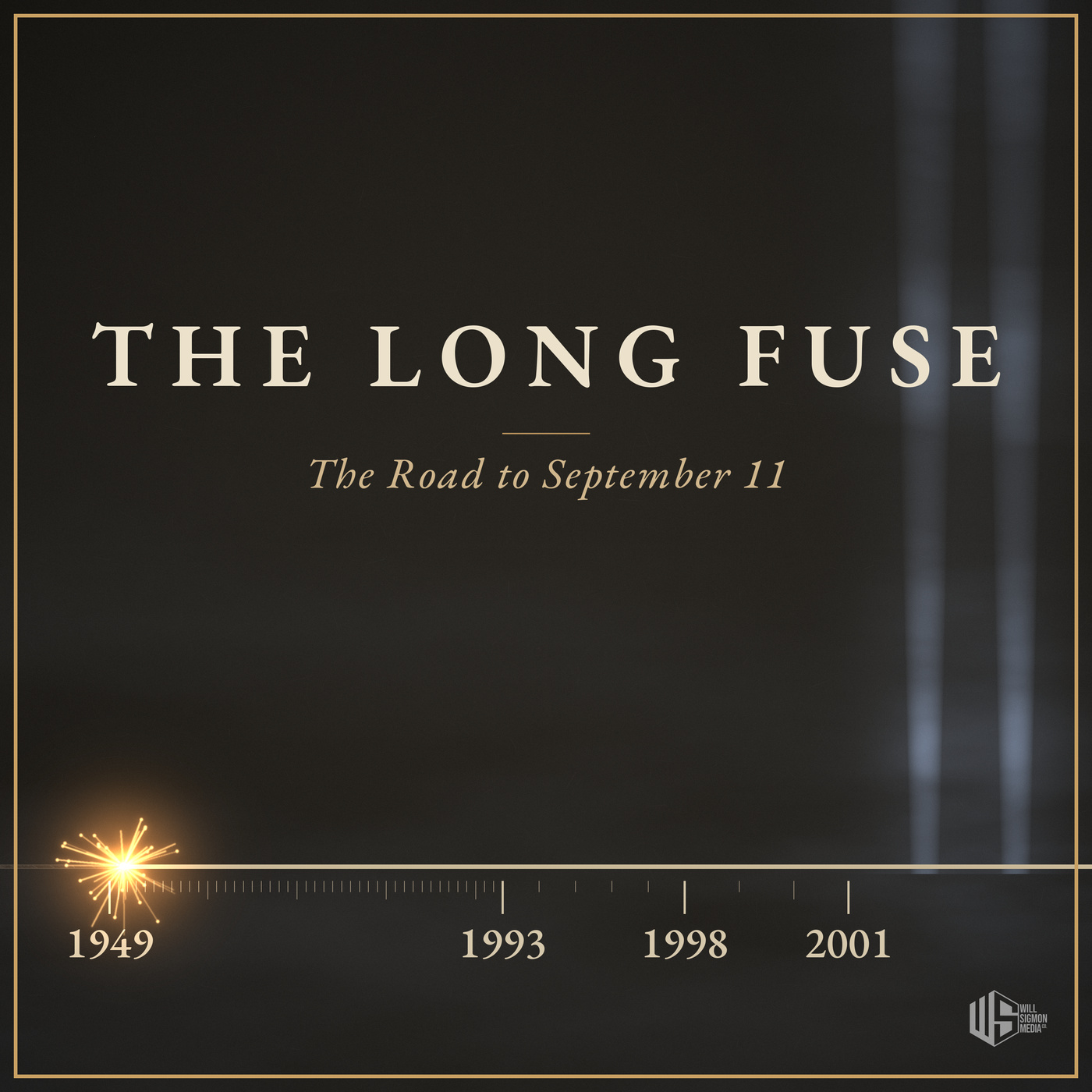
An audio drama · Season One · eight episodes
The Long Fuse
Fifty years of warnings. Eight episodes. One public record.
The road to September 11, 2001, told from the record. An audio drama narrated by The Record, built on the 9/11 Commission Report.
- Apple Podcasts coming soon
- Spotify coming soon
- RSS feed
Season One
Episodes
Trailer: The Long Fuse
August 6, 2001: a briefing whose title you already know. But the fuse was lit long before that summer. The Long Fuse is the story of how the September 11 plot was built, and how close the people trying to stop it came. Nobody's side. Dramatized from the public record; voices are AI-generated.
0:00 / 1:24Cold Outside
Minneapolis, August 2001: a flight school calls the FBI about Zacarias Moussaoui. Then back to 1948, when an Egyptian education official named Sayyid Qutb comes to America, studies in Greeley, Colorado, and goes home with what the 9/11 Commission calls "an enormous loathing of Western society and history." Episode 1 follows him from a church dance in Colorado to a Cairo gallows in 1966, and asks how his books outlived him.
0:00 / 34:34The Base
August 2001: an FBI analyst on loan to the CIA, working in her free time, finds the cable that puts a known al Qaeda associate inside the United States. Then back to 1979: revolution in Iran, the Soviet war in Afghanistan, the Arab volunteers who came to fight it, the rich young Saudi who helped pay for them, and the organization he and his mentor built when the war ended. Its name meant "the base."
0:00 / 33:59The Blind Sheikh
August 24, 2001: two names finally go onto a State Department watchlist. Then back to the early 1990s: bin Laden is pushed out of Saudi Arabia and builds a business empire in Sudan, a blind Egyptian cleric preaches in New Jersey, and a truck bomb explodes under the World Trade Center in February 1993. The investigation that followed was a success, and it still missed the bomber's uncle.
0:00 / 33:53The Declaration
August 28, 2001: a "Routine" lead asks New York agents to find Khalid al-Mihdhar. Then back to 1996: bin Laden's declaration of war, the CIA's bin Laden unit, and the years when the people paid to listen tried — and mostly failed — to make the rest of the government hear what he had said out loud.
0:00 / 34:01The Cole
August 29, 2001: a Cole case agent is told he cannot help find Mihdhar — the wall keeps him out. Then back to the millennium and October 12, 2000, when a small boat hit the USS Cole in Aden, and what followed when the people who investigated it were kept behind that wall.
0:00 / 34:00The Quiet Student
Before the plot had a name, there was a young man with a measuring tape. Episode 6 of The Long Fuse follows Mohamed Atta from a boyhood in Egypt's Nile Delta to Hamburg, to the camps in Afghanistan, to flight school in Florida and a hotel in Spain in July 2001, told as the 9/11 Commission and the record tell it, never from his side. It ends in Crawford, Texas, on August 6, 2001, with a briefing whose title you already know.
0:00 / 35:27Blinking Red
April to August 2001: the threat reporting grows so loud that, in the 9/11 Commission's words, "the system was blinking red." Episode 7 is the American side of that summer: the drumbeat of warnings, the reports that pointed overseas, the Phoenix memo, what the airlines were told, and a case opened in Minneapolis on August 15. The warnings were loud. Why did no one know where to look?
0:00 / 34:34The Morning
Tuesday, September 11, 2001. Told almost entirely in the Commission's words and times: four flights, the notices the military received, and what the record shows about that morning. No victim is voiced. Where people on the planes speak in the record, The Record says that they spoke, and what the Commission learned.
0:00 / 33:41
About the show
How it was made
The Long Fuse is a serialized audio drama about the road to September 11, 2001. It is told by a single narrator, The Record: neutral, precise, and never on the side of its subject.
The fuse is long. It runs from a homesick Egyptian education official at a church dance in Greeley, Colorado, in 1949, through the war in Afghanistan and the organization that came out of it, to a truck bomb under the World Trade Center in 1993, a Hamburg apartment, flight schools in Florida, and the summer of 2001, when, in the 9/11 Commission's words, "the system was blinking red."
Season One moves on two clocks. One counts down through August 2001, as analysts, agents and officials come within reach of the plot and miss it: a cable that sat unread for seventeen months, a laptop nobody was allowed to open, two names added to a watchlist far too late. The other goes back decades, to explain how a handful of men came to be in those rooms, on those visas, at those flight schools.
Why The Record: the story is told by a narrator that has no opinions and no favorites. It reads the documents, states what is known, says plainly what is not, and marks the places where the sources disagree. When the Commission found no evidence for a popular claim, The Record says so. When a detail rests on a single account, or on statements made in custody, it is attributed as such.
How it is made: the backbone is The 9/11 Commission Report, with footnotes, checked line by line against the official text. Other sources, including court records, trial testimony and published books, are named in each episode's show notes, and secondary or contested claims are flagged as such. Quotations are read verbatim. Some scenes and dialogue are reconstructed or composited from documented events and played by unnamed composite characters. Allegations in court filings are unproven claims.
What it will not do: no victim is voiced, quoted or depicted. There is no attack-day content. No hijacker speaks, and no sermon, speech or justification is ever performed. The people the Commission protected with pseudonyms stay protected.
The Long Fuse is produced with AI-generated voices. The Record and the composite characters are synthetic voices and are not intended to resemble any real person. The show is independent and is not affiliated with or endorsed by any person or agency depicted.
Who it is for: anyone who remembers the day and has wondered how it was possible, and anyone too young to remember it who wants the long version, not the myth. The Long Fuse assumes nothing and explains every name, acronym and agency the first time it appears.
A note on names: the show writes and says "bin Laden"; quotations from the Commission Report keep the Report's own spelling, "Bin Ladin."
The record
Sources
Every episode lists its sources, with full transcripts and chapter markers alongside the audio.